


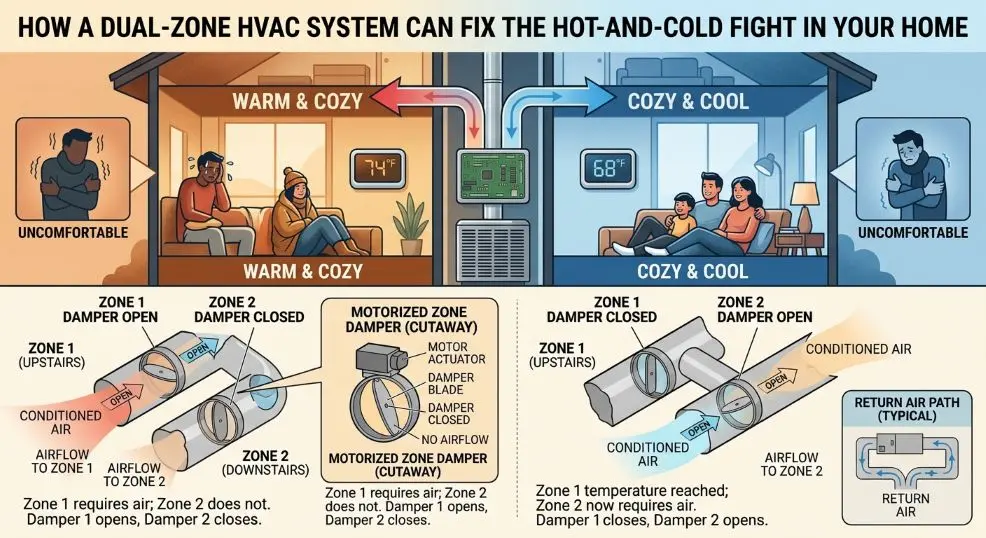
If you live in a two-story home around Crystal Lake, Volo, or McHenry, you already know the argument. The upstairs bedroom is stuffy while the living room feels like a walk-in cooler, and no matter where you set that single thermostat, somebody is uncomfortable. A dual-zone HVAC system was built to end that fight for good. Instead of one thermostat trying to heat and cool your home evenly from top to bottom, a dual zone setup splits your house into two areas that each hold their own temperature.
What a Dual-Zone HVAC System Actually Does
A single-zone system treats your entire house as one zone. One thermostat, one reading, one compromise. A dual-zone HVAC system uses zone dampers inside your ductwork to control airflow to different areas of your home. When the upstairs calls for cooling and the downstairs is already comfortable, the dampers open and close to send warm or cool air exactly where it’s needed. You still have one air handler or furnace doing the work, but now two thermostats give each zone its own temperature settings. See the image below to better understand the layout.

This matters a lot in northern Illinois, where the climate swings hard. During a January freeze, heat rises and leaves your first floor cold while the second floor gets really hot. Come July, that same lake-effect humidity makes upstairs bedrooms miserable at night. With zoning systems in place, each zone gets the heating or cooling it needs instead of one blanket setting for the whole house.
The Real Benefits: Comfort and Efficiency
The obvious win is comfort throughout your home, but the energy savings are just as real. When you stop over-conditioning rooms nobody is using, your HVAC system runs less. A home office you only use during the day doesn’t need the same attention as the bedrooms at night. That reduced runtime means less wear and tear on your HVAC equipment and lower ComEd and Nicor Gas bills through our long heating season.
Here’s how the payoff tends to break down:
- Cost savings from not heating and cooling the entire house to one setting
- Even temperatures across a multi-story home, floor to floor
- Longer equipment life because the system cycles only when a zone truly needs it
For homes where adding zones to your HVAC ductwork isn’t practical, ductless mini-splits offer another path. Each indoor unit tied to an outdoor unit creates its own zone with no ductwork required, which works well for additions and older homes common in Lake County.
What Does a Dual-Zone HVAC System Cost?
The cost of a dual-zone conversion depends on your existing HVAC, your ductwork layout, and whether you’re adding zones to an existing furnace or installing new equipment. Converting your current HVAC to dual zone with dampers and a second thermostat is usually far less than a full replacement. A heat pump or ductless setup will price differently.
The honest answer is that every home is different, and a quick look at your duct system tells us far more than a phone estimate ever could.
Is Zoning Right for Your Home?
If you’ve got a multi-story home, rooms that never feel right, or a family that fights over the thermostat, upgrading to a dual-zone HVAC system is worth a serious look. Our HVAC experts at Optimized Air know Lake County and McHenry County homes inside and out, from Libertyville’s older housing stock to newer builds in Vernon Hills.
Ready to stop the hot-and-cold standoff? Reach out to Optimized Air and let’s talk about whether a dual zone system fits your home.
Ready to Optimize Your HVAC System?
At Optimized Air Heating & Cooling, our certified technicians can analyze your specific home setup and recommend the ideal fan operation strategy for your unique needs. We’ll help you balance energy efficiency with comfort and air quality.
Call us: (224) 338-9591
Email: [email protected]
Mention code “SMARTFAN” for 15% off your next maintenance service!